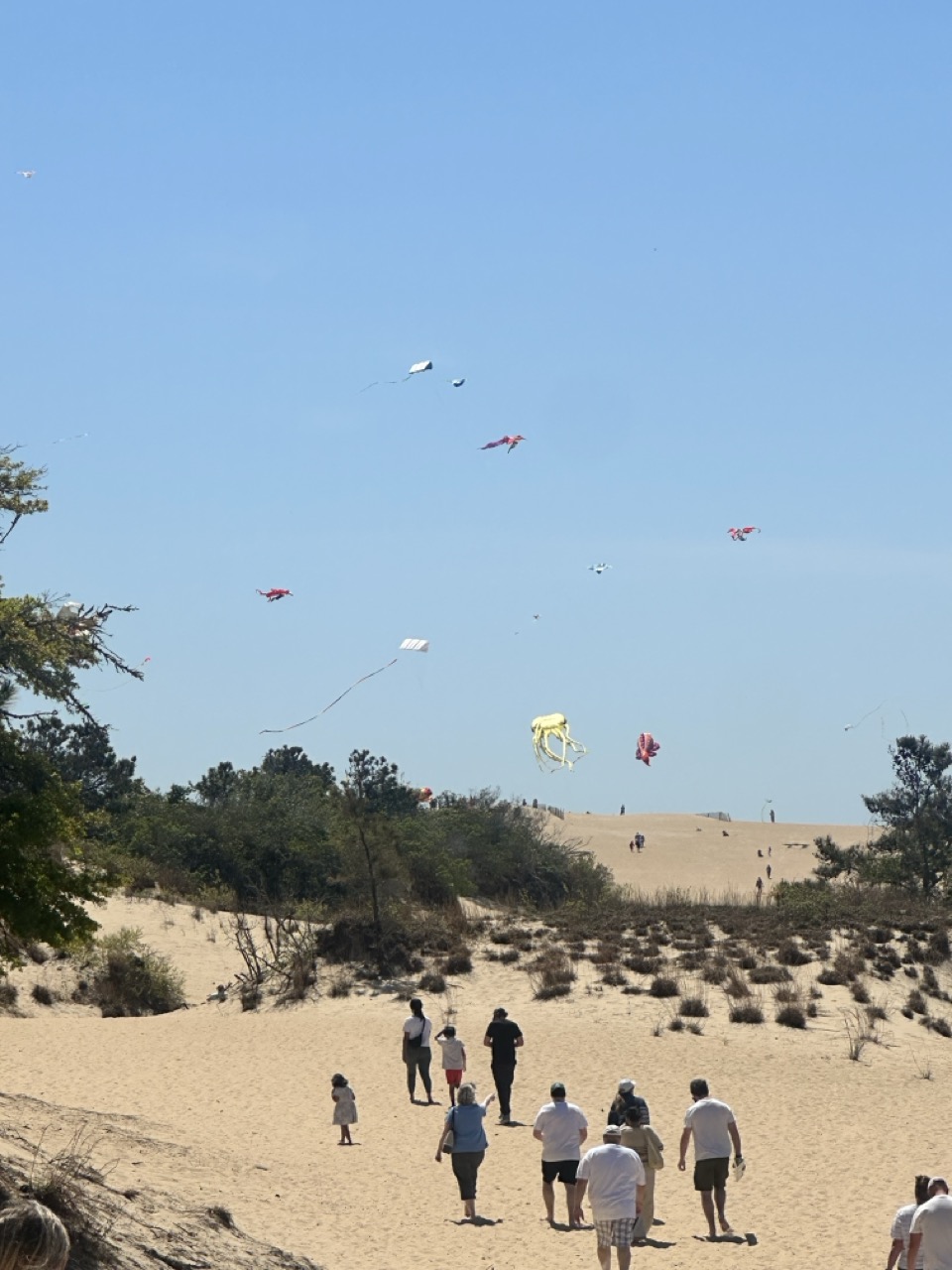
A dune that moves
Drive along US-158 through the beachside strip of Nags Head — past rental cottages, ice cream shops, and surf shops — and suddenly an enormous dune rises against the sky. Jockey's Ridge is what's called a medano: a massive, unvegetated dune system that isn't anchored in place the way most dunes are. It migrates south-southwest with the prevailing winds at roughly 3 to 6 feet a year, constantly reshaping itself and swallowing whatever's in its path — a 1970s mini golf course near the dunes was slowly buried by the sand's advance over the following decades.
The dunes rise 80 to 100 feet above the surrounding landscape — the tallest living sand dune system on the Atlantic coast. The 427-acre park holds three distinct ecosystems: the dune system itself, the maritime forest, and Roanoke Sound along its western edge. It was saved from development and established as a state park in 1975, after the ridge earned National Natural Landmark status the year before.
What to do there
🪁 Kite flying
The open dunes and steady coastal wind make this one of the best kite-flying spots on the East Coast — bring your own or pick one up nearby.
🪂 Hang gliding lessons
A private concessionaire (Kitty Hawk Kites) runs beginner hang gliding lessons right on the dunes — the same slopes where the Wright Brothers themselves once tested glider designs before Kitty Hawk.
🏄 Sandboarding
Rent a sandboard from the on-site concessionaire and ride the dunes like a snowboard run — no lift required, just the climb back up.
🌅 Sunset watching
The park's biggest free show. Climb the dunes an hour before sunset, find a ridge, and watch the sky go orange over the sound — a local tradition, not just a tourist one.
🥾 Tracks in the Sand Trail
A 384-foot boardwalk nature trail leads to an overlook with interpretive panels on the dunes' plants and animals — an easy, mostly flat option if you'd rather not climb the open sand.
🏊 Roanoke Sound access
A second park access area on the sound side allows swimming, paddling, kiteboarding, and windsurfing in calmer water — a different side of the park entirely.
Good to know before you go
- Free admission — no entrance fee; only optional lessons, rentals, or event permits cost extra
- Hours are seasonal — the park opens at 8am year-round, closing anywhere from 6pm (winter) to 9pm (peak summer); the ridge itself closes about 15 minutes before the park
- No shade, hot sand — sand temperatures can run up to 30°F hotter than the air; bring water, sun protection, and footwear you don't mind filling with sand
- Dogs welcome — on a 6-foot leash, everywhere except inside buildings
- No camping — it's a day-use park only; the visitor center has restrooms, water, and exhibits on dune ecology
- GPS caution — some map apps route incorrectly to private property; search the park's address directly rather than just "Jockey's Ridge"